
Fuel Emergency Diversion Explained What UK Passengers Need To Know
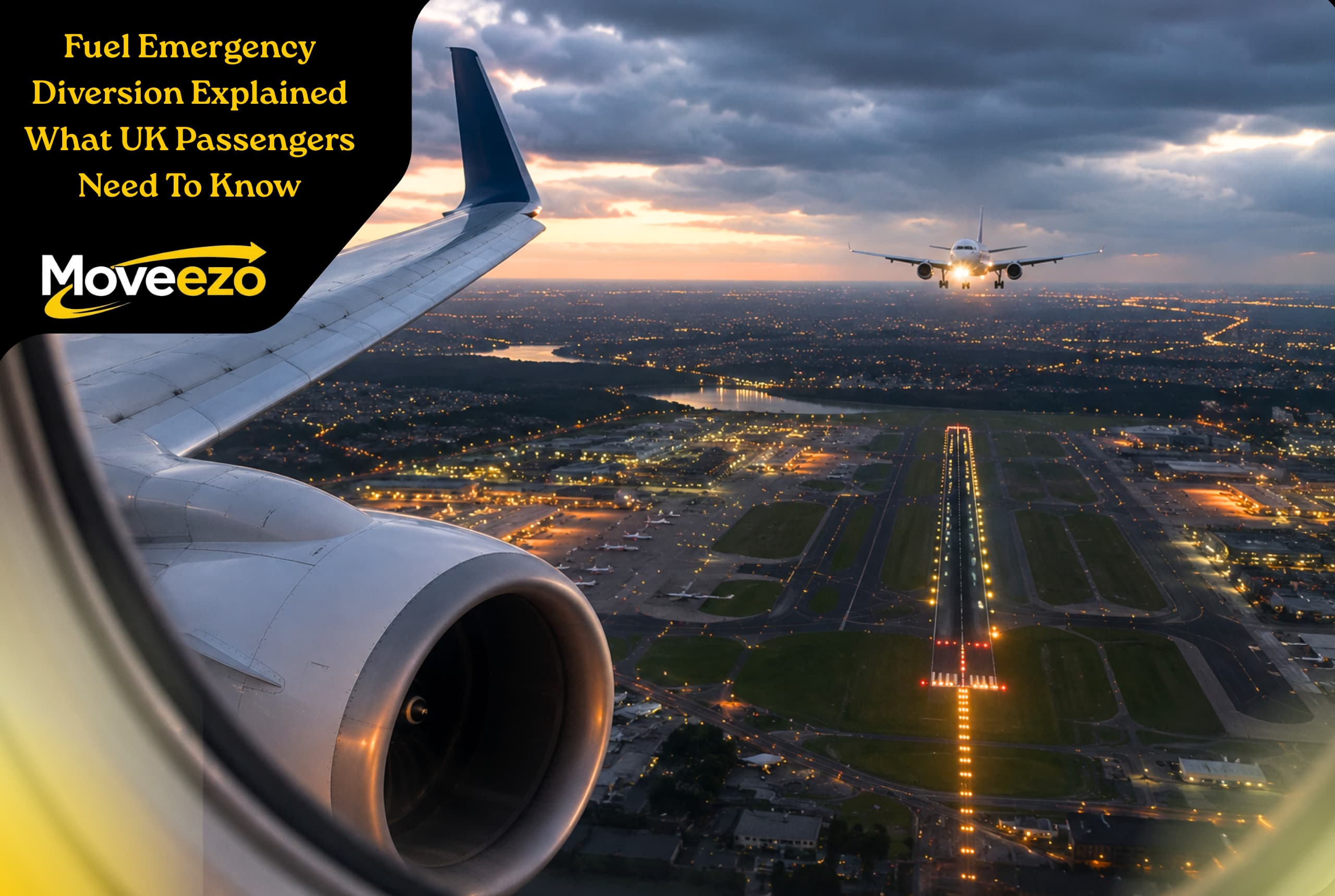
A fuel emergency diversion sounds alarming the moment you hear it announced, but for pilots and air traffic controllers it is a well-rehearsed safety procedure, not a sign that anything has gone catastrophically wrong. When a flight can no longer safely hold in the air or continue to its planned airport, the crew declares an emergency and lands at the nearest suitable runway, ahead of every other aircraft in the queue.
|
A fuel emergency diversion happens when a flight's remaining fuel is expected to drop below the legal final reserve (roughly 30 minutes of flying time) before it can land. The pilot declares an emergency, squawks the transponder code 7700, and air traffic control gives that aircraft priority to land immediately, either at the original airport or the nearest alternative. |
This guide explains why these diversions happen, walks through two recent UK and European cases that made headlines, sets out your passenger rights, and gives you a practical step-by-step plan for what to do the moment your flight is diverted, including how to get from an unfamiliar airport to your original destination without losing the rest of your day.
What Is a Fuel Emergency Diversion
A fuel emergency diversion is declared when a flight crew judges that the aircraft will land with less than its required final reserve fuel, generally around 30 minutes' worth at holding altitude, if it continues on its current plan. Regulations set by the UK Civil Aviation Authority and the European Union Aviation Safety Agency require every commercial aircraft to carry enough fuel to reach its destination, hold if necessary, divert to an alternate airport, and still land with that reserve untouched.
When circumstances such as a blocked runway, bad weather, or extended holding eat into that buffer, the crew has one job left: get the aircraft on the ground safely and quickly. Declaring an emergency is how they secure that priority.
How Pilots Declare Squawk 7700
Pilots communicate a fuel emergency to air traffic control verbally and by switching the aircraft's transponder to the internationally recognised code 7700. This code flags the flight on every controller's radar screen as needing immediate attention. Controllers then clear surrounding traffic and route the aircraft to the nearest runway capable of accepting it, whether that is the original destination or a diversion airport.
It is worth repeating what aviation authorities and airlines stress every time this happens: an emergency landing fuel shortage declaration is a precautionary safety trigger, not proof that an aircraft is about to run out of fuel mid-air. It simply means the crew will not accept further delay.
Why Fuel Emergency Diversions Happen
Most fuel emergencies trace back to something outside the pilot's control that extends the flight beyond its planned fuel burn. The most common triggers are:
● A runway blockage caused by another aircraft, debris, or a technical fault
● Extended holding patterns during busy periods or poor visibility
● Sudden bad weather, including storms or crosswinds that force a go-around
● Air traffic control capacity restrictions at congested UK airports
● A diversion to an alternate airport that itself becomes unexpectedly delayed
Two recent incidents illustrate exactly how this unfolds in practice.
Case Study: British Airways Gatwick Fuel Emergency
In July 2026, a British Airways Gatwick fuel emergency made headlines after Airbus A320 flight BA2673, arriving from Palma de Mallorca, suffered a nose wheel steering fault and became stranded on Gatwick's only operational runway overnight. With the southern runway already closed for maintenance, the airport had no backup, and every inbound aircraft was forced into holding patterns over the South East.
Nine of the fourteen aircraft affected ultimately declared fuel emergencies as their reserves fell towards the legal minimum while they waited. Flights were sent to Luton, Stansted, Birmingham, Bristol, and even Heathrow, which broke its usual night curfew to accept one arrival. The runway itself was blocked for around 29 minutes, but the ripple effect of holding, rerouting, and re-crewing lasted well into the following day.
Case Study: Ryanair FR5448 Fuel Emergency Diversion
A similar sequence played out with the Ryanair FR5448 fuel emergency diversion a few days earlier. The Boeing 737-800, flying from Seville to Nantes, was forced to abandon its landing after an Iberia regional jet suffered an engine failure on take-off and scattered debris across Nantes Atlantique's single commercial runway.
The crew held at low altitude while controllers tried to clear the runway, but as fuel dwindled, the captain declared an emergency, climbed to 20,000 feet, and diverted to Brest Bretagne Airport under priority vectoring. Ryanair confirmed the aircraft landed with fuel above its final reserve and in full compliance with regulatory requirements. Passengers were later transferred back to Nantes once the airport reopened.
Recent Fuel Emergency Diversions Compared
The table below summarises both incidents alongside the underlying pattern that connects almost every fuel emergency diversion.
|
Incident |
Trigger |
Airports Involved |
Outcome |
|
British Airways BA2673, July 2026 |
Nose wheel fault blocked Gatwick's only runway |
Gatwick, Luton, Stansted, Birmingham, Bristol, Heathrow |
9 fuel emergencies declared, 14 diversions, runway reopened after 29 minutes |
|
Ryanair FR5448, July 2026 |
Debris from another aircraft's engine failure blocked Nantes runway |
Nantes, Brest Bretagne |
1 fuel emergency, safe diversion, passengers coached back to Nantes |
|
Ryanair FR3418, October 2025 |
Storm Amy winds prevented landing at two airports |
Prestwick, Edinburgh, Manchester |
Fuel mayday declared, safe landing at Manchester |
Is a Fuel Emergency Diversion Dangerous
Passengers understandably find the term frightening, but aviation authorities are consistent on this point: a fuel emergency is a regulatory trigger for priority handling, built deliberately into the system so crews act well before fuel reserves become genuinely critical. The final reserve itself is a buffer on top of the fuel needed to reach an alternate airport, so declaring an emergency still leaves a real safety margin.
That said, the UK Air Accidents Investigation Branch does review clusters of emergencies, such as the nine declared at Gatwick, to understand whether airport infrastructure or air traffic procedures need improvement. Reviewing these events is standard practice and does not imply passengers were ever in danger.
Your Rights After a Diverted Flight in the UK
If your flight was diverted and you experience diverted flights UK style delays as a result, UK261 (the UK's retained version of EU261) may entitle you to assistance and, in some cases, compensation:
● Right to care: meals, refreshments, and hotel accommodation if you are delayed overnight, regardless of the cause
● Free transport between the diversion airport and your original destination, or to your accommodation
● Compensation of up to £520 if you arrive at your final destination more than three hours late and the cause was within the airline's control
● No compensation obligation where the diversion resulted from extraordinary circumstances such as severe weather or a safety-critical technical fault beyond routine maintenance
● A refund or rerouting option if the airline cannot get you to your destination within a reasonable timeframe
Keep every receipt for meals, transport, or accommodation you pay for yourself, and note the exact arrival time at your original booked destination, since compensation eligibility is calculated from that point, not from your arrival at the diversion airport.
What To Do Immediately After a Flight Diversion
A calm, methodical response makes a genuine difference when you are unexpectedly sitting at the wrong airport. Follow these steps:
1. 1. Check the airline app or website first for rebooking and assistance information.
2. 2. Ask ground staff directly about meals, hotel vouchers, and onward transport entitlements.
3. 3. Photograph boarding passes, delay notices, and any receipts as you go.
4. 4. Contact anyone waiting for you or connecting travel providers so they know your revised arrival plan.
5. 5. Arrange transport onward from the diversion airport if the airline's own coach service is slow, full, or does not suit your schedule.
Getting From the Diversion Airport to Your Original Destination
This last step is where most of the real-world stress lives. When nine aircraft divert into Luton, Stansted, Birmingham, and Bristol in one night, as happened during the British Airways Gatwick fuel emergency, airline coaches fill up fast and taxi ranks empty just as quickly. A pre-booked airport transfer after diverted flight disruption gives you a fixed price and a guaranteed vehicle, rather than queuing behind hundreds of other stranded passengers.
Moveezo tracks flight status in real time, so if you book a delayed flight taxi or transfer with us and your flight is diverted, our team adjusts your pickup point and timing at no extra hassle to you. Whether you land at Luton after a Gatwick diversion or need an airport taxi after flight diversion from Stansted back towards central London or the South East, you can request an emergency airport transfer through moveezo.com and reach your original destination, hotel, or event without relying on overstretched airport coaches.
If your itinerary also includes onward flights, our flight booking service can help you rebook a connecting leg quickly, while our hotel booking platform is useful if a diversion forces an unplanned overnight stay near the alternate airport.
Diverted Flight Onward Travel Options Compared
|
Option |
Pros |
Cons |
|
Airline coach transfer |
Usually free when arranged by the airline |
Limited seats, long queues, fixed departure times |
|
Public transport (rail or bus) |
Low cost, widely available from major diversion airports |
Multiple changes, luggage handling, late-night gaps in service |
|
Pre-booked private transfer |
Fixed price, door-to-door, adjusts to your actual landing time |
Needs booking, though this can be done from your phone in minutes |
|
Standard taxi rank |
Available on arrival with no booking needed |
Prices can surge during mass diversions, availability is unpredictable |
Business Traveller Tips
Business travellers feel diversion disruption hardest because meetings do not move to accommodate a runway closure. Build a buffer of at least two hours before any fixed London meeting when flying into Gatwick or Heathrow during peak summer or winter storm periods. Save your itinerary and a transfer provider's number in your phone before you fly, so you can rebook ground transport the moment a diversion is announced rather than after landing.
Family Travel Tips
Diversions are harder on children, who tire quickly and need regular food and rest breaks. Pack extra snacks and a change of clothes in hand luggage for exactly this scenario. If your family is diverted overnight, ask the airline for accommodation suitable for children early, since family rooms are limited and go first.
Accessibility Advice
Passengers with mobility needs should tell cabin crew and ground staff about any equipment or assistance requirements as soon as a diversion is announced, since diversion airports may not have the same accessibility set-up as your booked destination. A wheelchair accessible taxi can be arranged in advance for onward travel, avoiding the uncertainty of finding suitable transport on arrival.
Cost Considerations
A diversion itself should not cost you money if the airline meets its Right to Care obligations, but real-world queues mean many passengers end up paying for transport, food, or a night's stay and claiming it back later. Budget for these costs upfront, keep every receipt, and check current fuel and running costs if you are considering a rental car as a backup option; our guide to UK fuel prices covers current petrol and diesel costs across the country.
Common Mistakes to Avoid
● Assuming a diversion automatically means compensation, without checking whether it falls under extraordinary circumstances
● Throwing away receipts for meals, transport, or accommodation paid for personally
● Waiting in a single queue for hours instead of checking the airline app for faster rebooking options
● Booking the first available taxi at inflated on-the-spot pricing instead of comparing a pre-booked transfer
● Forgetting to update anyone waiting at your original destination airport
Myths About Fuel Emergencies
Myth: A fuel emergency means the plane is about to run out of fuel mid-air. Reality: it means the crew wants priority landing before reserves drop below the legal 30-minute minimum.
Myth: Fuel emergencies are rare, isolated events. Reality: they happen periodically at busy airports whenever a single runway closure creates knock-on holding, as both UK case studies above show.
Myth: Every diverted passenger is owed compensation. Reality: compensation depends on the cause; technical faults handled outside standard maintenance and severe weather are often classed as extraordinary circumstances.
Local Insight: Heathrow, Gatwick and UK Diversion Airports
A Heathrow flight diversion or Gatwick airport disruption tends to send aircraft to a predictable set of alternates: Luton, Stansted, Birmingham, Bristol, and occasionally Manchester or Cardiff. Each of these airports has its own transport links, and none of them are guaranteed to have spare taxi capacity during a mass diversion event. Knowing this in advance, and having a transfer booked or bookable in minutes, is the single most practical thing a UK traveller can do to protect the rest of their journey.
If your trip includes onward sightseeing or an event once you finally reach London, browse events and attractions to rebuild your schedule around the time you actually have left, and see our comparison of Heathrow to Gatwick transfers if your diversion has you needing to move between London's two largest airports.
Conclusion
A fuel emergency diversion is a safety system working exactly as intended, not a sign of danger. Whether it is a Ryanair flight diverting into Brest or nine aircraft declaring emergencies over Gatwick in a single night, the pattern is the same: a blocked runway or unexpected delay eats into the fuel buffer, and the crew takes the safest, fastest route to the ground. Knowing your rights, keeping your receipts, and having a reliable way to complete your journey from whichever airport you land at turns a stressful night into a manageable inconvenience.
If your flight is diverted anywhere in the UK, Moveezo can get you moving again. Book an emergency airport transfer, a delayed flight taxi, or a same-day hotel through moveezo.com and one of our team will track your new arrival time and adjust your pickup automatically. Call us on +44 20 3504 6075, email info@moveezo.com, or reach out via our contact page any time, day or night. Moveezo covers airport taxis, flights, hotels, events, holiday packages, car rentals, and city-to-city transfers across 140+ countries, so wherever your diverted flight lands, we can help you finish the journey.
Frequently Asked Questions
What does a fuel emergency diversion mean?
It means the flight crew expects to land with less fuel than the legal final reserve, generally around 30 minutes, unless given priority handling. The pilot declares an emergency and squawks code 7700, and air traffic control clears the way for an immediate landing at the nearest suitable airport.
Why did Ryanair flight FR5448 divert?
Ryanair FR5448, flying from Seville to Nantes, was forced to abandon its landing after debris from another aircraft's engine failure closed Nantes Atlantique's only runway. After holding while fuel reserves fell, the crew declared a fuel emergency and diverted safely to Brest Bretagne Airport.
What happened during the British Airways Gatwick fuel emergency?
A British Airways A320 suffered a nose wheel fault and became stuck on Gatwick's only working runway. With no backup runway available, fourteen inbound flights were diverted and nine declared fuel emergencies while holding, landing instead at Luton, Stansted, Birmingham, Bristol, and Heathrow.
Am I entitled to compensation if my flight is diverted?
You may be entitled to up to £520 under UK261 if you arrive at your final destination more than three hours late and the cause was within the airline's control. Diversions caused by extraordinary circumstances, such as severe weather or an unforeseen safety fault, typically do not qualify.
Is it safe to fly if fuel emergencies are increasing?
Yes. A fuel emergency is a precautionary safety trigger built into aviation regulations specifically so crews secure priority landing well before fuel becomes genuinely critical. Authorities review clusters of emergencies to improve airport procedures, not because passengers were ever in danger.
How do I get from a diversion airport back to my original destination?
Airlines typically arrange coach transport, but during mass diversions seats run out quickly. Pre-booking a private airport transfer, such as those offered by Moveezo, guarantees a vehicle and adjusts automatically to your actual landing time and airport.
What is squawk 7700 and why do pilots use it?
Squawk 7700 is the international transponder code for a general emergency. Switching to this code alerts every air traffic controller on the aircraft's route that it needs immediate priority, whether the cause is a fuel emergency, medical issue, or technical fault.
Can bad weather cause a fuel emergency diversion?
Yes. Storms, high winds, or low visibility can force repeated go-arounds or extended holding, as happened when Storm Amy prevented a Ryanair flight from landing at both Prestwick and Edinburgh before it diverted to Manchester with a declared fuel emergency.